Weddings and Receptions
A Wedding Reception Timeline
Build an hour by hour reception schedule with arrival, dinner service, toasts, cake cutting and dancing, and the small buffers that save the day.
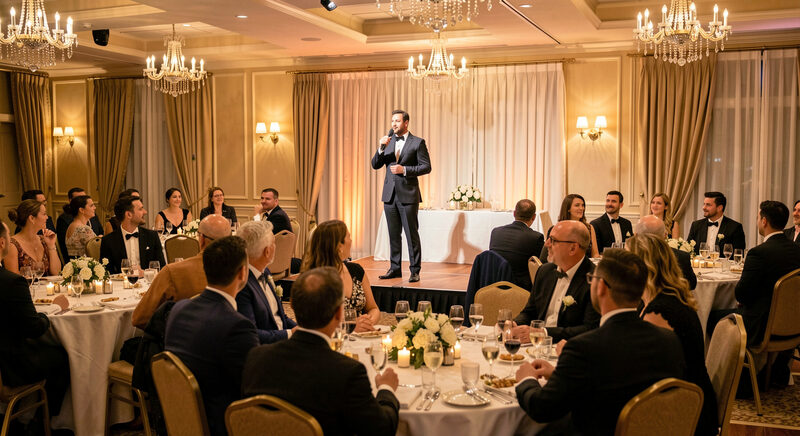
The difference between a reception that feels calm and one that feels rushed is almost never the budget. It is the schedule. A reception is a sequence of moments that depend on one another, and when one runs long, everything after it is squeezed. The fix is a timeline built with the venue, the caterer and the DJ, with a few deliberate buffers where the day can breathe.
What follows is a working schedule for an evening reception, the cues that keep it moving, and the places where a little slack saves the whole evening.
Build the timeline backwards from the end
Most venues rent the room for a fixed number of hours, and the end time is the least flexible point of the evening. Start there and work backwards. If the room closes at eleven, the last dance is around ten forty-five, the send-off is just before that, and the dancing has to begin by eight to give it a real run. Working backwards from the hard stop is the simplest way to see whether the plan fits the hours you have paid for.
Then place the meal, the toasts and the cake in the middle, and leave the arrival and the cocktail time at the front. The result is a plan with a shape rather than a list.
Arrival and cocktails
Guests arrive, sign the guest book, drop gifts and cards, and find a drink and a seat. This is the softest part of the evening and it can absorb delays elsewhere. Give it forty-five minutes to an hour. It is also when the couple, if they are taking photographs after the ceremony, are often still busy, so a cocktail hour with food and music keeps guests happy while the photographs finish.
Ask the venue where the guest book and the card box will sit, so arriving guests are not left guessing. These small wayfinding decisions are part of the layout, which is covered in capacity and room layout.
Announcement and seating
The couple is announced and the guests move to their tables. Allow fifteen minutes for this transition, because it takes longer than it looks when a large room is finding its seats. The caterer usually needs the room seated before serving the first course, so the announcement is really the starting gun for the kitchen. Tell the DJ and the caterer the same time, and let the venue confirm it, so nobody is waiting on a signal that never comes.
Dinner service
A plated dinner of three courses usually takes between an hour and ninety minutes to serve to a large room, depending on the number of servers and the size of the kitchen. A buffet moves faster per guest but starts with a queue, and a double-sided buffet serves a big room far quicker than a single line. Ask the caterer how long the service will take for your guest count, and write that number into the timeline rather than guessing.
If there are speeches, decide whether they come during dinner or after. Speeches between courses can slow the kitchen; speeches after the meal give guests a settled audience. Either works if the choice is made in advance. The meal itself is compared in buffet or plated dinner.
Toasts and the cake
Toasts need a microphone that works and a room that is quiet. Allow ten to fifteen minutes for the toasts, with the speakers told in advance how long they have. Then the cake cutting, which is short but needs a table, a knife, plates and someone to serve the slices. Ask the caterer whether there is a cake-cutting fee and who plates the cake, because this is one of the small charges that appears late on a bill.
Place the toasts and the cake close together so the formal part of the evening has one centre, then clear the floor and let the dancing take over.
Dancing and the send-off
Give the dancing at least ninety minutes if you want it to build. The first dance, the parent dances and any group dances belong at the start of the dancing block, not in the middle of dinner, so the floor opens with energy. A DJ who knows the schedule will call the guests to the floor; a band will do the same. Keep the bar open through the dancing, and plan a last call before the end so the room winds down rather than stops.
If there is a send-off, whether sparklers, bubbles or a simple line of guests, leave ten minutes for it and tell the photographer and the DJ in advance. It is a small moment that falls apart if it is improvised at the door.
Buffers, and the cues to watch
Build in three buffers of ten to fifteen minutes: one after the ceremony, one between dinner and the toasts, and one before the send-off. A wedding day almost always runs a little late, and buffers absorb that without pushing the end time. Agree with the venue and the DJ on a single cue for each transition, so everyone is reading the same clock. The person who holds the schedule should be one person, not three.
Print the timeline and give a copy to the venue, the caterer, the DJ and the photographer. A schedule that lives only on a phone in someone's pocket is a schedule that gets lost.
Where this fits
The timeline is the spine of the reception, but it rests on decisions made earlier: the room, the meal and the bar. Couples who have not yet settled those can start with wedding receptions and choosing a banquet hall. Once the room and the meal are fixed, the schedule above can be filled in with real times and handed to the people who will run the evening.