Choosing a Venue
Questions to Ask a Banquet Hall
Bring this list to every tour: what is included, what costs extra, who staffs the room, when you may decorate and what happens if plans change.
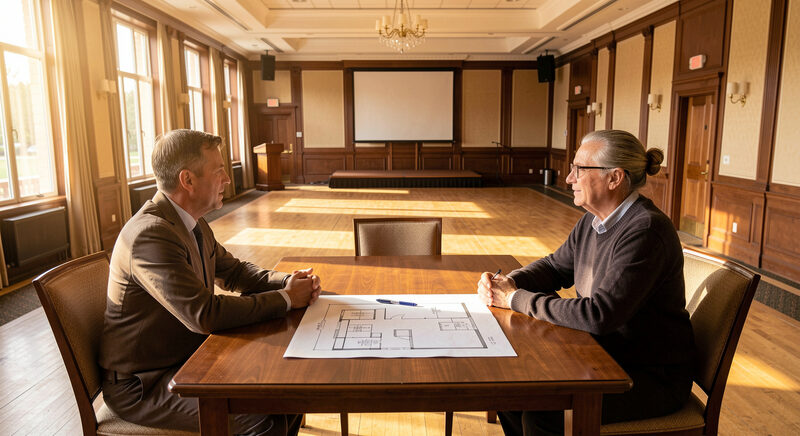
A venue tour is a sales conversation, and it is easy to leave having seen the chandeliers and the dance floor without knowing the four or five facts that decide whether the hall actually suits the event. The fix is to arrive with a written list. A hall that answers the list clearly is usually a hall that runs its events clearly, and the answers themselves become the first draft of the contract.
The questions below are grouped the way a booking actually unfolds: the room, the money, the food and drink, the people, and the paperwork. Bring a pen and write the answers down while they are still fresh.
Capacity and the room you will actually get
Ask how many guests the room seats at round tables, how many it seats at long tables, and how many it holds standing. Ask whether the event will have the whole room or a section of it, and whether a movable wall will divide it from another party on the same evening. A hall that shares a wall with a second event can be perfectly fine, or it can put a loud band next to a quiet memorial lunch, and the difference is worth knowing in advance.
Ask to see a floor plan for the guest count you are planning, with the dance floor, the bar, the stage and the buffet marked. If the venue cannot produce one, that is itself an answer. The arithmetic behind those plans is set out in capacity and room layout.
Money: what the price includes
Ask for the price in writing, item by item. Then ask which of the following are included and which are added: tables, chairs, linens, tableware, glassware, a dance floor, a stage, a sound system, a microphone, coat racks, a gift table, a cake table, and staff to set the room up and clear it down.
Ask what triggers an extra charge: additional hours, a room reset, a second bar, a cake-cutting fee, a corkage fee, a kitchen fee if you bring your own caterer, and any charge for cleaning. Ask whether a service charge and sales tax are added to the quoted total, and what percentage each one is. The full method for turning two quotes into a true cost per guest is in what a banquet hall costs.
Food and drink
Ask whether the hall cooks on site, works with a fixed list of caterers, or lets you bring your own. If it has its own kitchen, ask to see a sample menu and ask how dietary needs are handled: vegetarian, gluten-free, allergies, and meals for children. Ask how the food is served, buffet or plated, and how long the kitchen needs between courses. The trade-offs are covered in buffet or plated dinner.
On drink, ask who serves the alcohol and who holds the licence, whether the bar is cash or open, and what the hall charges for bartenders. In Ohio this is not a detail to leave to the day, and the rules are gathered in bar service and Ohio liquor rules.
Staff, timing and access
Ask how many staff will be in the room, what they do, and whether a manager stays for the whole event. Ask when you may arrive to decorate, when the room must be cleared, and whether setup and cleanup time is included in the rental or billed separately. A hall that lets you in two hours early is a different proposition from one that lets you in twenty minutes before the doors open.
Ask about parking, the drop-off point at the entrance, step-free access, restrooms, and the temperature of the room in the evening. These practical questions are gathered in parking, access and guest comfort.
Contracts, deposits and cancellation
Ask for the contract and read it before paying anything. Ask what the deposit is, whether it is refundable, and what happens to it if the guest count drops or the date changes. Ask how the balance is paid and when, and whether the hall requires a minimum spend or a minimum guest count. Ask what insurance the venue carries and what it expects from you, especially for a club or a charity running a fundraiser. A short, plain contract is a good sign; the general principles of reading a contract before signing apply here as anywhere.
Ask, finally, what happens if the venue has to cancel, and whether a deposit is returned or moved to another date. Nobody plans for that, and the answer tells you a lot about the hall.
The questions people forget
Ask who else will be in the building that night, whether there is a noise curfew, and whether the room has air conditioning for a summer wedding or heat for a winter party. Ask whether you may bring your own cake, your own decorations, and candles, and whether anything may be attached to the walls. Ask where the band or DJ plugs in and how loud the room can go before the sound bounces off the walls. Ask whether the hall has a preferred list of vendors and whether choosing someone else costs more.
Ask for the names of two recent clients you may call. A hall that will not give a reference is a hall worth pressing on.
Turning the answers into a decision
Back home, put the answers beside the quote and compare halls on the same page. The room that answered every question plainly, even the awkward ones about fees and cancellation, is usually the room that will feel calm on the day. If the answers are vague, the tour was not finished; go back and ask again, or move on to the next hall on the list in choosing a banquet hall.