Planning and Logistics
Parking, Access and Guest Comfort
Plan parking, drop off, step free access, seating for older guests and a coat and gift area so arrival and departure stay calm.
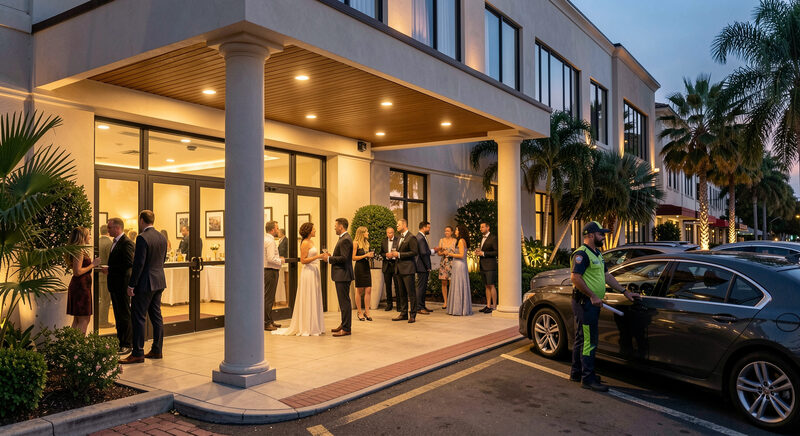
Guests form their first impression of an event before they reach the door, in the parking lot and on the walk to the entrance. They form their last impression on the way out. Both are easy to get right and surprisingly easy to get wrong, and neither costs much to plan. A calm arrival and a calm departure make an evening feel well run, whatever is happening inside.
This guide covers parking, drop-off, step-free access, seating for guests who need it, and the small comforts that keep an event easy for everyone.
Parking, and how much of it you need
Ask the venue how many parking spaces it has and whether the lot is shared with another event. Two parties in one building on the same evening can empty a lot quickly. Street parking works in some West Side neighborhoods and fails in others, especially on a Friday or Saturday evening, so it is worth knowing which situation applies. If the lot is small, ask whether there is an overflow lot nearby or a shuttle.
A hall that hosts large events will usually have thought about this and will have an answer ready. If it has not, that is a question to press on before signing.
The drop-off point at the door
A covered or at least clearly marked drop-off point at the entrance helps older guests, anyone with limited mobility, and the family carrying a cake, a gift table and a box of decorations. Ask where a car can stop without blocking traffic, and whether the venue can put a sign or a person there at the busiest moment, which is the half hour before the start. A short, well-placed drop-off spares a lot of small stress.
Step-free access and the entrance
An entrance with steps is a problem for a wheelchair, a walker, a stroller and a guest with a recent injury. Ask whether the entrance is step-free and, if not, whether there is an accessible alternative door and how a guest would find it. Ask about the route from the parking lot to the door and whether it is lit and clear of ice in winter. These questions belong in the venue tour, alongside the ones in questions to ask a banquet hall.
Seating for guests who need it
Plan the seating with the oldest and the least mobile guests in mind. A seat near the door, away from the speakers and close to the restrooms, is a kindness. So is a table that is not squeezed against a wall and a clear path through the room. If the event is a memorial reception or a milestone party, where several guests may need help, tell the venue in advance so the layout can account for it.
The general layout arithmetic is in capacity and room layout.
Restrooms, and finding them
Ask where the restrooms are, whether there is an accessible one, and whether they are on the same level as the event. A guest should not have to ask three people to find the restroom. A simple sign, or a line in the programme or the welcome, solves it.
Coat storage, gifts and the guest book
In winter, a coat rack or a staffed coat area keeps the room tidy and the guests comfortable. A table for gifts and cards, placed where it can be watched and near the entrance, is standard. A guest book needs a pen and a clear place to sit. These small stations are part of the layout and take up space, so they belong in the room plan rather than being added on the day. The buffet and the bar also need their own space, covered in buffet or plated dinner and bar service and Ohio liquor rules.
Weather, season and the walk outside
An Ohio winter can turn a short walk into a careful one. A lit path, a cleared and salted walkway, and a warm entrance make a real difference in January. In summer, shade and a cool room matter just as much, and guests arriving in the heat appreciate water at the door. Ask the venue how it handles the season, and whether the room stays comfortable when it is full of people.
Transport and getting home
If the event serves alcohol, plan how guests will get home. A list of local taxi and rideshare numbers, printed and left at the bar or the door, is a small courtesy that prevents a large problem. For a wedding or a company party, a shuttle between a hotel and the hall keeps guests off the road and keeps the parking lot manageable. Ask the venue whether buses or shuttles can drop off at the entrance and where they should wait, because a coach that cannot reach the door defeats the point.
For guests who arrive by bus or on foot, check the nearest stop and the condition of the walk. A lit path and a clear route make the difference between an easy arrival and an anxious one, and in winter it is worth asking the venue who clears the walk and when.
The departure
The end of an evening deserves the same thought as the start. Guests leaving in the dark need a lit path to the lot, and a send-off, if there is one, needs a clear route and a little time. Arrange transport for anyone who should not drive, and keep the exit uncluttered. A well-planned departure leaves guests with the feeling that the whole evening was looked after, from the first parking space to the last goodbye.
These practical details are the quiet half of planning and logistics, and they begin with the venue tour described in choosing a banquet hall.